Virtual WAN with Azure Firewall
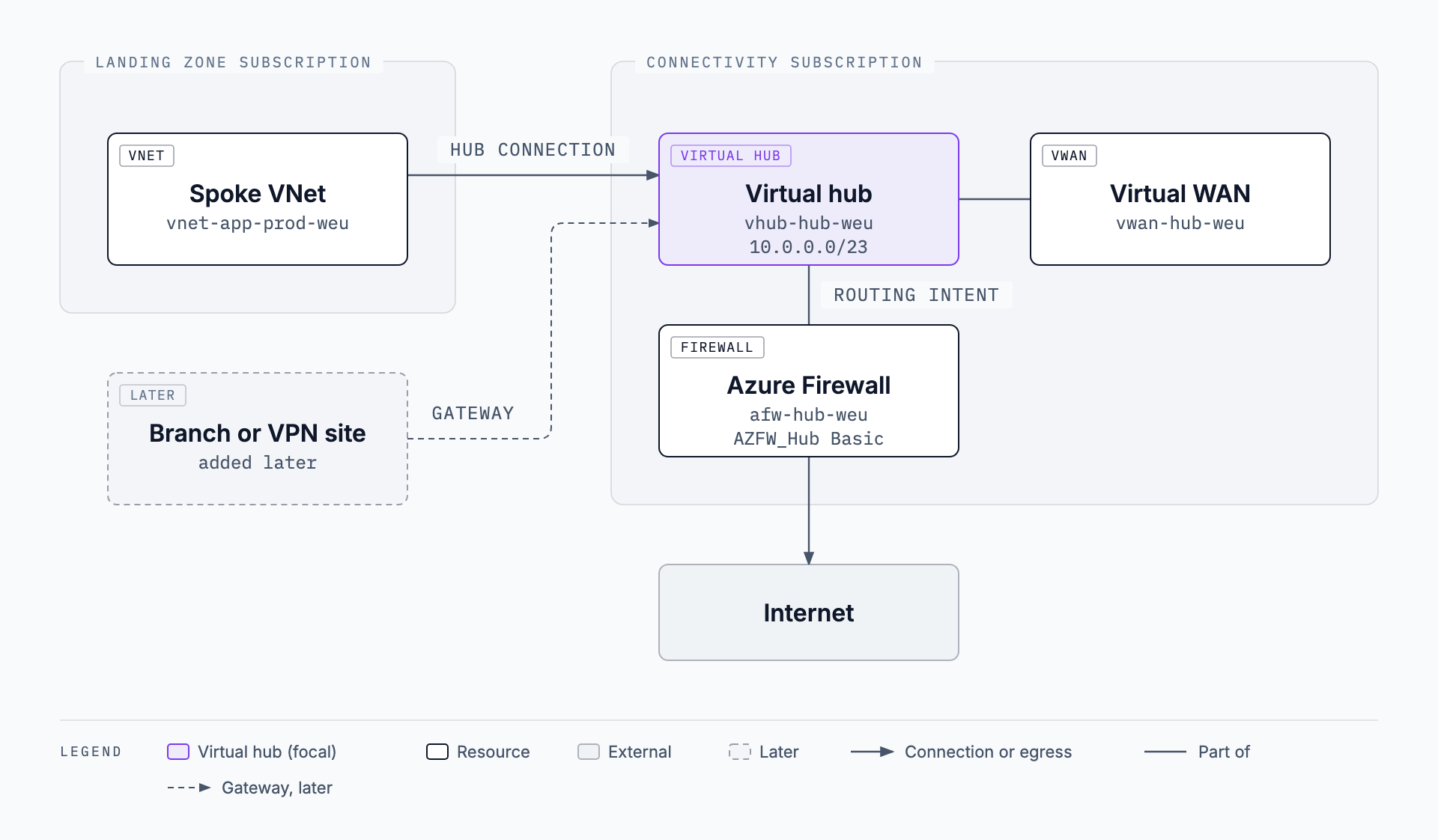
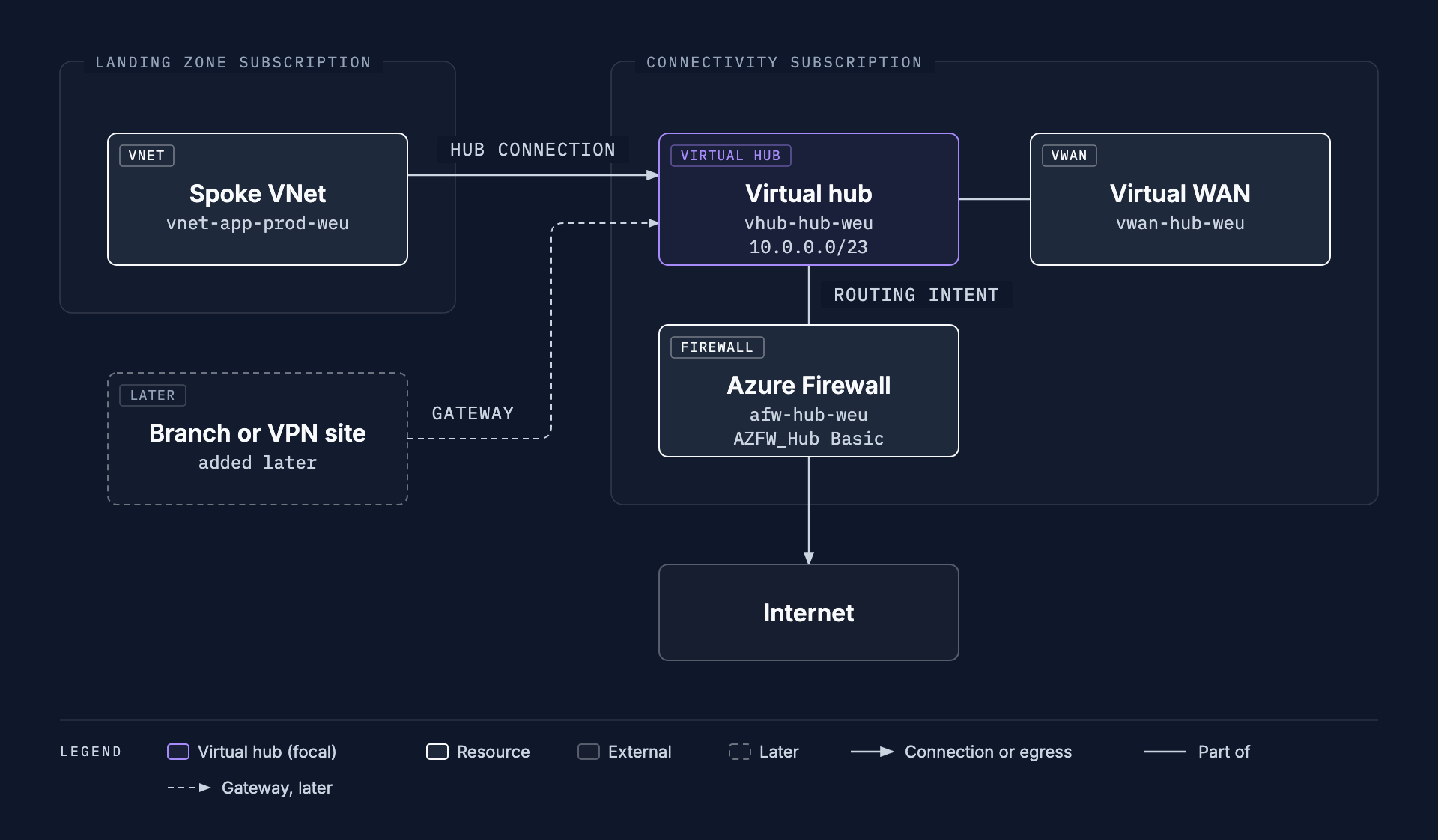
A Virtual WAN with one secured virtual hub: the hub router, a Basic Azure Firewall inside the hub, and its policy. Spokes connect to the hub instead of peering to a hub virtual network, and routing intent sends their internet traffic through the firewall. This is the SMB default of the ALZ accelerator and the shape NRIT recommends to customers that will grow: branch sites, SD-WAN and a second region attach to the same Virtual WAN without re-plumbing the spokes.
Example: examples/connectivity/vwan-firewall/.
What it deploys
| Resource | Module | Version |
|---|---|---|
rg-hub-weu |
Azure/avm-res-resources-resourcegroup/azurerm |
0.4.0 |
vwan-hub-weu (Standard), vhub-hub-weu (10.0.0.0/23), afw-hub-weu (AZFW_Hub, Basic), afwp-hub-weu (Basic) |
Azure/avm-ptn-alz-connectivity-virtual-wan/azurerm |
0.18.0 |
Module docs
Links point at the pinned version. The module examples are applied by the module's own CI on every release.
Not deployed: the sidecar virtual network, Bastion, both gateways, private DNS zones and resolver, the DDoS plan.
Idle cost. The Standard virtual hub bills about USD 0.25 an hour, roughly USD 185 a month, whether or not it carries traffic, and the Basic firewall about USD 290. A secured-hub firewall cannot be deallocated. That is why NRIT's own reference environment stays on the minimal hub. The example is validated against the module schema and by plan, not by a standing deployment.
The tree you add
live/platform/connectivity/
├── subscription.hcl
├── env.hcl
└── westeurope/
    ├── region.hcl
    └── caf-connectivity-vwan/
        ├── terragrunt.hcl
        └── main.tf
Decisions in the example
- Spokes connect from their own unit.
virtual_network_connectionsis not used here. Each landing zone's network unit setsvwan_connection_enabled = truewith the hub's resource id, so adding a landing zone never changes the hub unit. - Routing intent, internet only. The spoke's
vwan_security_configurationsetsrouting_intent_enabledandsecure_internet_traffic. Private traffic stays direct between spokes; turn onsecure_private_trafficon the spoke when east-west inspection is wanted. Routing intent itself is configured on the hub outside the module. - Basic firewall in the hub. The same trade-offs as the hub and spoke variant. Moving to Standard re-creates it.
- No private DNS zones in the hub. Virtual WAN hubs do not host DNS zones; with this scenario the zones live in a sidecar virtual network or in the management subscription. The example leaves them off; add the sidecar when the first private endpoint arrives.
- Hub address prefix
/23. Azure's minimum is/24;/23leaves the hub router room to scale.
On the spoke side
In the landing zone's network unit, swap the two commented pairs: comment out
the hub virtual network locals and the three hub_peering lines, and
uncomment the virtual hub locals and the vwan_connection_enabled block.
The hub id is derived from the connectivity subscription and vhub-hub-weu.
Point the unit's dependencies at caf-connectivity-vwan. Leave
route_table_enabled off: routing intent replaces the spoke route table.
tflint fails the commit hook on a declared local that nothing uses, which is
why the locals move together with the block.
Apply order
_foundation/landing-zones, this unit (the hub and firewall take twenty to
thirty minutes), then each landing zone. A hub connection applies in minutes.
What people get wrong
- Mixing peering and hub connections. A spoke is either peered to a hub virtual network or connected to a virtual hub, never both.
- Expecting zone links on the hub. There is no hub virtual network to link private DNS zones to. Plan the sidecar or the management subscription for DNS before the first private endpoint.
- Tearing down to save money. The firewall and hub cannot be paused. Destroying and re-creating the hub changes nothing for the spokes' config, but every hub connection re-applies.
- Forgetting the runners. With self-hosted runners, the bootstrap runner network stands alone. To let a pipeline reach a private endpoint in a spoke, connect the runner network to the virtual hub like any spoke, with a hub connection and not a peering. Bootstrap does not create that connection.
About the cost figures
Fixed infrastructure only, list prices, one region, from the ALZ accelerator's scenario pages (US dollars, west US, 2026-04-02) and the Azure pricing pages. Data processing, log ingestion and DNS queries are on top and vary. The infracost gate on your pull request reports the figure for your region and currency before you apply.